Explained
Competitor price monitoring, explained
Competitor price monitoring is checking, every day, what other shops charge for the same products you sell, and being told when that changes. A webshop with two hundred products and three competitors has six hundred prices to keep an eye on. A tool does the looking; you decide what to do with what it finds.
The trial has every feature, on 100 products and 3 competitor shops. Then you connect your shop, in about two minutes. Servers in Germany.

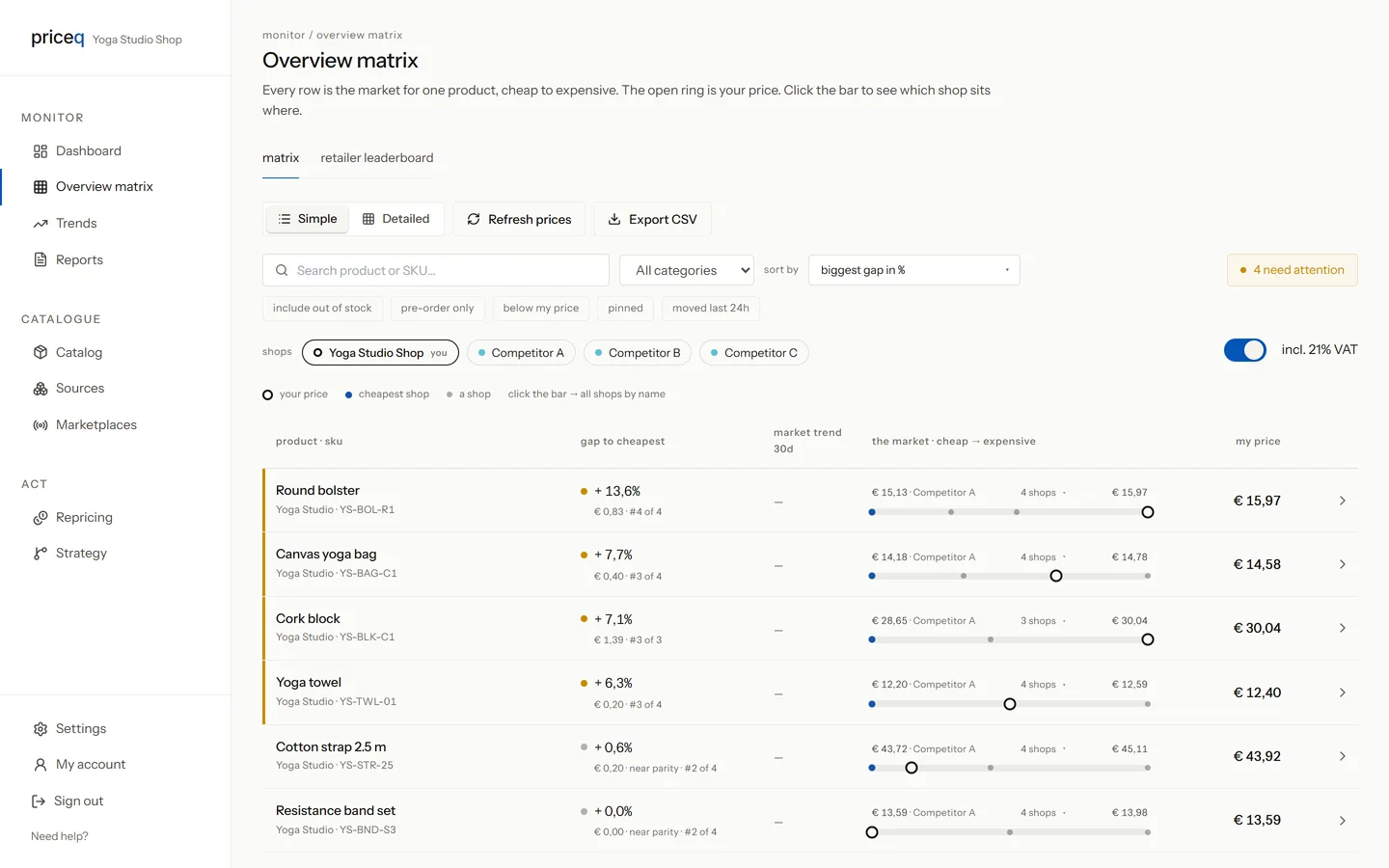
What a monitoring tool actually does
Four things, in order. It takes your catalogue, ideally straight from your shop, so it knows which products you sell and what you charge. It finds the same products at the shops you name, by their EAN, the number on the barcode, so that a competitor’s "Yoga mat 6 mm blue" is tied to your yoga mat and not to a different one. It fetches those competitor pages every day and records the price it finds, with the date. And it compares: your price against theirs, today against yesterday, and tells you when something crossed a line you set.
The last step is where tools differ most. A cheap tool shows you a table. A better one turns the table into a short list: which of your prices are wrong, in which direction, and since when.
Why the EAN matters more than anything
Matching is the part that goes wrong quietly. Two shops rarely name a product the same way, and a tool that matches on titles will happily tie your 6 mm mat to a competitor’s 4 mm one and then tell you that you are too expensive. The EAN is the same number everywhere, so a match on it is a match. Ask any tool how it matches, and what it does when the EAN is missing. The honest answer is "we ask you", through a review queue. The dishonest one is "we guess".

Tracked over time, not sampled
A competitor who drops a price on Friday evening and puts it back on Monday morning is invisible to a tool that checks on Monday afternoon. Prices need to be recorded as a series, so a move shows up even if it has already been undone, and so you can see whether a shop is structurally below you or just ran a weekend promotion. Once a day is the minimum that catches most of it; twice a day catches the rest.

Put your own catalogue on the board. Fourteen days, no card.
Start 14 days freeAlerts with a threshold you set
A one-cent difference is not news. A monitoring tool should let you say how far a price has to move before it tells you, per kind of event: a competitor undercutting you, a competitor who has been more expensive for a week (room to move up), a sudden move in one day, a new shop selling your product, a shop dropping it, and a product going out of stock at several shops at once. The threshold is what turns six hundred data points into the four things worth reading this morning.
Monitoring is not repricing
Monitoring tells you. Repricing changes your prices, usually on a marketplace, usually automatically, usually to win a buy box. The two get mixed up because some tools do both. For a webshop, the useful middle ground is a proposal: the tool suggests a price, shows the rule and the numbers behind it, respects a floor you set, and waits for you to approve it before anything is written to your shop, unless you switch that rule to push on its own. That keeps a person responsible for the price, which is what most shop owners want and what an accountant expects.

What to look for in a tool
A direct connection to your shop platform, so the catalogue is never a spreadsheet you have to keep uploading. Matching on EAN with a review queue for the rest. A price history, not a snapshot. Thresholds per alert type. A clear answer to where your data is stored and who can see it. And a price that fits a catalogue of hundreds, not tens of thousands: most tools in this market were built for large retailers and price accordingly.
What you do not need: a dashboard with thirty charts, an "AI pricing engine", or a competitor list that includes every marketplace in Europe. Three competitors, watched properly, beat thirty watched badly.
What priceq does
priceq connects to Shopify, WooCommerce and Magento 2, matches on EAN with a review queue, checks once or twice a day, keeps the history, and sends alerts by email and in the app with a threshold per type. From the Business plan it proposes prices that show their rule and never go below your floor, and pushes them to your shop after you approve, or on their own if you switch a rule to automatic, inside your guardrails. It runs on Outflanq’s own servers at Hetzner in Germany. Plans start at €99 a month for 200 products.
Questions
How often should competitor prices be checked?
Once a day catches most moves; twice a day catches short promotions and end-of-day changes. More often than that rarely changes a decision for a webshop, and costs more.
Is scraping competitor prices legal?
Reading publicly shown prices is common practice and how every price comparison site works. What matters is doing it politely, at a modest rate, and not copying anything beyond the price and availability.
Can I do this in a spreadsheet?
For ten products and one competitor, yes, for a while. It stops working the week you forget to do it. Our guide on how to track competitor prices shows where the spreadsheet ends.
What is the difference with a price comparison site?
A comparison site shows shoppers who is cheapest today. Monitoring shows you, the shop, how your prices sit against named competitors over time, per product, and what changed.
Does monitoring work for brands and distributors?
Yes. A brand watches how its retailers price its products; a distributor watches the shops it supplies. The mechanics are the same; the alerts you care about differ.